Data infrastructure
Compute & shared storage
A faster compute node cannot recover time spent waiting for files. Follow the dataset through ingest, local scratch and shared storage before buying drives or network ports.
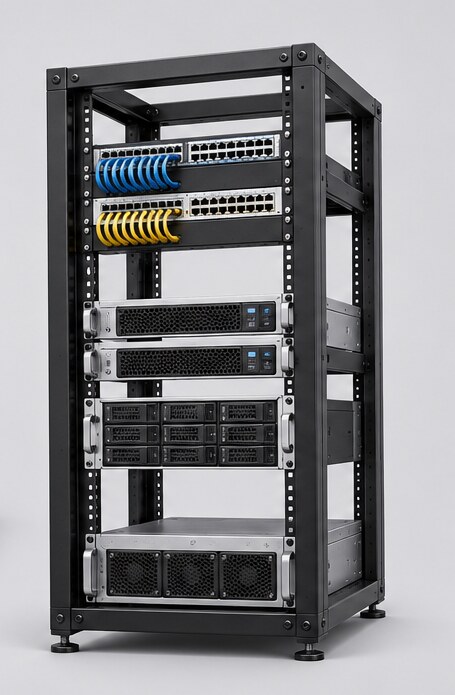
Configuration choices
Which part of the data path is slow?
Reading source files
Several workers open the same assets at once.
Measure simultaneous reads with representative files. A single large copy can hide small-file latency.
Writing temporary data
Intermediate outputs crowd the shared volume.
Compare local scratch with shared scratch. Set a cleanup policy and identify which files must survive a node failure.
Keeping results
Completed jobs need a durable destination.
Define usable capacity, retention and restore time. Redundancy within an array is not a separate backup.
Worked example
Add up concurrent reads.
Four workers each reading 200 MB/s demand 800 MB/s in aggregate before protocol overhead. Increasing switch speed helps only if the storage, uplinks and client adapters can also sustain that rate.
What to bring for testing
- List active, retained and temporary data separately, with expected growth.
- Record the network link speed and storage protocol at both ends.
- Run concurrent read/write jobs, then restore a sample output from a separate backup.